Archives:

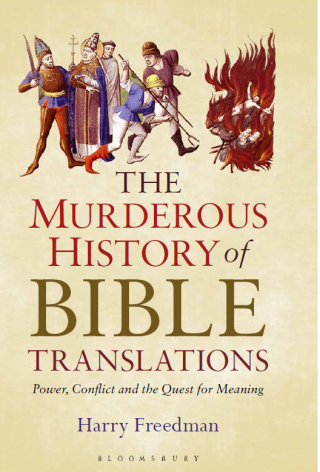
The Murderous History of Bible Translations

The Murderous History of Bible Translations

The history of the translated Bible is one of passion, conflict and even violence. Time and again the seemingly innocent act of transposing the sacred text into another language has been seized upon to advance a cause, instigate upheaval, incite rebellion or maintain a grip on power. At other times the translated bible has been marshalled as a bulwark against such designs.

For ordinary people the bible itself is a guide to belief and life. But for its translators, and their opponents, it could just as easily become a weapon in whatever struggle they were waging. Regulating the bible’s accessibility, giving people greater or lesser insights into what it teaches, has proved to be a powerful way of exerting control or promoting new thinking.
Books 1

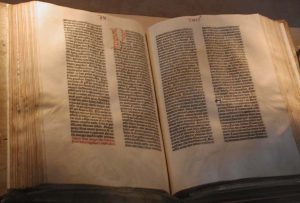
Gutenberg Bible, 1450s

The Murderous History of Bible Translations begins with the story of the Septuagint, the first known Bible translation. It moves on to discuss the tales of three people who translated the bible to advance their political or religious beliefs. William Tyndale did so from a Reformer’s perspective, battling obscurantism, corruption and papal tyranny. He paid with his life. The nineteenth century American abolitionist and campaigner against social injustice, Julia Smith, helped lay the early foundations of feminism with her translation of the bible. And long before either of them, Saadia Al-Faiyumi, a ninth century Jewish philosopher, used it in his campaign against literalists and sectarians who threatened to bring down the edifice of rabbinic Judaism. He endured exile and ignominy for his pains.

There’s a theme which runs through the story of Bible translations. It is of the translated bible as an instrument of social or political change. The theme becomes evident even when we look back at the ancient translations. The activists were not always those who made the translations, sometimes it was their opponents, for example those who reacted against the Septuagint and the Peshitta. But Origen, Jerome and Wycliffe were on the side of the radicals, as were lesser known translators such as Mesrop Mashtots, Little Wolf and Moses Mendelssohn.

Of course, not all translations were controversial. Some, such as King James’s enterprise appeared to be wholly benign, a noble venture to clothe the divine word in literary magnificence. But we only have to peel away the façade to discover the manipulative, establishment-driven agenda beneath.

Today, when Western society is no longer centred on the Bible, its translators have abandoned grand upheaval, focusing instead on single issues. But they still exude passion, and a belief that the Bible translated after their fashion will bring about the change they so fervently desire. Even if they are unlikely to pay for it with their sanity, freedom or life.
Kabbalah- Secrecy, Scandal and the Soul

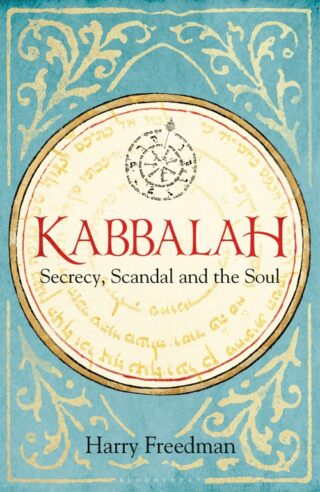
Kabbalah- Secrecy, Scandal and the Soul

Kabbalah was never meant to be fashionable. Its earliest exponents; deeply mystical, other-worldly Jews, studying in closed, secretive groups, in twelfth century Provence would have been amazed, and probably horrified, to hear how far and wide their doctrine has spread and how universal it has become.

The recent interest in Kabbalah emerged out of the hippy movement’s fascination with mysticism and meditation in the 1960s. It became particularly popular with the advent of New Age spirituality in the late 20th century, when it was feted as a powerful technique for personal development. This was not Kabbalah as it had been practised in the 12th century. But Kabbalah has always evolved, changed, and bifurcated into different strands. The 20th century was by no means the first time that Kabbalah had broken away from its early, exclusively Jewish confines.

This book tells the story of Kabbalah’s origins, its development and spread, up to the present day. Our story begins in the first centuries of the Common Era with a group of Jewish mystics whose curiosity about the nature of heaven inspired them to embark on mystical voyages of discovery to the heavenly palaces.

Subsequent chapters trace the evolution of this mysticism, as it entered Christian Europe and Muslim Spain. It was not yet known as Kabbalah; the name did not emerge until the 12th century shortly before the appearance of the Zohar, its most enigmatic text. Allegedly composed by Shimon bar Yohai, a 2nd century rabbi in the Land of Israel, kabbalists believe that the Zohar lay concealed for over a thousand years until it surfaced in the Castille region of Spain in the 13th century. Historians believe no such thing.

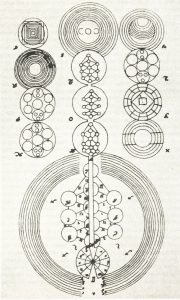
Sefirot

Diagram of Sefirot from Knorr von Rosenroth’s Kabbalah Denudata


One of Kabbalah’s distinguishing features is that its techniques can be applied in many different contexts. Christian Cabala is a case in point. Conceived at the high point of the Renaissance, in Lorenzo de’ Medici’s Florence, Christian Cabala became allied to magic, alchemy and Hermeticism occult. Kabbalah contributed to the Scientific Revolution and played a central part in the 19th century occult revival.

At the same time as Christian Cabala was beginning to forge new paths, Jewish mystical fraternities in the Northern Israel city of Safed were pushing at classical Kabbalah’s boundaries. Their work reached its peak in the thought of Isaac Luria, who developed the doctrine of heavenly exile, a necessary act, essential for the creation of the world.

The approach of modernity did nothing to lessen Kabbalah’s appeal to the dreams and fantasies of the masses, nor to diminish its disruptive potential. A messianic crisis rooted in Kabbalah rocked the Jewish world in the seventeenth century. Its repercussions could be felt across Europe, they still reverberate today. A hundred years later Kabbalah was instrumental in creating Hasidism, the most vibrant, yet antimodern of all Jewish religious movements.

Kabbalah became fashionable in the late twentieth century. The Kabbalah Centre, famous in its heyday for its celebrity devotees, developed what has been called Kabbalah-lite, formulating mystical remedies and personal development techniques designed to respond to the stresses and traumas of modern life. Buffeted by accusations of sexual offences and financial misdemeanours, its short history has been rocky. But it has nevertheless won as much praise as condemnation.

Today, Kabbalah exists in many incarnations, and is taught from many perspectives; its story is far from over. I have tried in this book, to provide a flavour of its history.

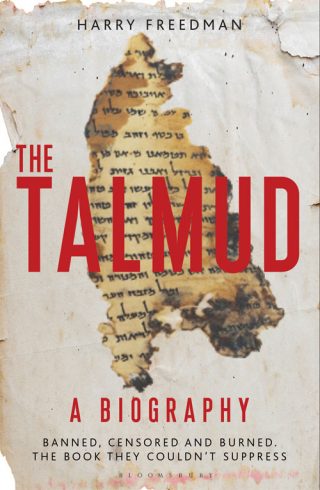
The Talmud: A Biography

The Talmud: A Biography

This is the story of a book. Most books don’t have their own story, at best they have a narrative about their publishing history and subsequent reception by the public. But the Talmud has more than just a story, it has a turbulent history. One which, in many ways, parallels the history of the Jewish people.

The Talmud was composed as a record of discussions amongst scholars and sages in the ancient Jewish diaspora, in towns and villages close to Baghdad. As the Jews dispersed across the world, the Talmud went with them, travelling along trade and migratory routes into the Maghreb, Europe, Arabia and the East. It became the foundation of the Jewish legal system, the bedrock of the Jewish faith. It became more important to the Jews than the Bible itself.

They exchanged perspectives and ideas with their neighbours. Early contacts between Judaism and Islam produced an intense, intellectual cross-fertilization, the effects of which can still be discerned in Talmudic and Islamic law. The medieval encounter between the Jews and Christianity was less benign, the Church regarded the Talmud as the obstacle which prevented them from converting the Jews. Their response was to challenge, burn, ban and censor it.

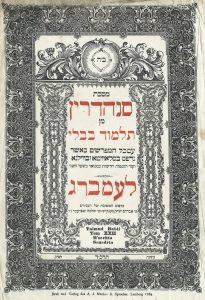
Talmud Sanhedrin Lemburg

Title Page, Talmud Sanhedrin, Lemburg, 1864. (Library of Jewish Community in Bielsko-Biala, Poland)

Later generations, particularly in Protestant Europe, although just as intent on converting the Jews nevertheless explored the Talmud for ideas. We find philosophers and poets, republicans and kings, priests and professors all probing the Talmud, seeking inspiration, support or validation for their particular points of view.

The most intractable of the Talmud’s challenges came from the Jews themselves. Rejectionists,  messianic pretenders and savants vilified it, seeking to delegitimize or at the very least to minimize its influence. But like the Jews themselves, the Talmud’s capacity for survival is boundless. Today it is studied by more people than at any time in its history.

The Talmud is a classic of world literature. It’s a massive, ancient and seemingly impenetrable work. People devote their lives to studying it. But you are not reading a book about what is in the Talmud. This is the story of what happened to the Talmud, and the role it has played in world history, religion and culture. It’s not a book for experts, or for specialists. It’s a book for anyone who wants to know the story of one of the great classics of ancient literature, albeit one which is far less heavily thumbed, outside of Jewish circles, than Homer, Chaucer or Ovid. The content of the Talmud may be esoteric. But its history belongs to us all. For there is scarcely a square inch of the world’s surface upon which its story was not, at some time, acted out.

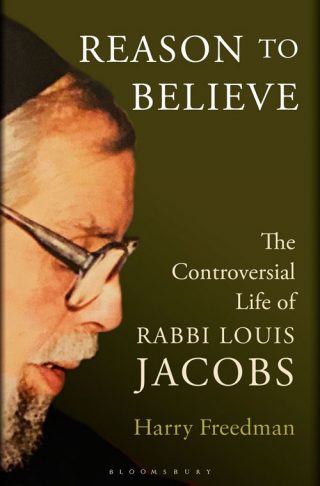
Reason To Believe

Reason To Believe

Louis Jacobs was Britain’s most gifted Jewish scholar. A Talmudic genius, outstanding teacher and accomplished author, cultured and easy-going, he was widely expected to become Britain’s next Chief Rabbi.

Then controversy struck. The Chief Rabbi refused to appoint him as Principal of Jews’ College, the country’s premier rabbinic college. He further forbade him from returning as rabbi to his former synagogue. All because of a book Jacobs had written some years earlier, challenging from a rational perspective the traditional belief in the origins of the Torah.

***

In 2005 the Jewish Chronicle conducted a poll of its readers to mark 350 years since Oliver Cromwell allowed the Jews to return to England. The newspaper aimed to highlight the contribution made by the Jewish community to national life, by asking its readers to decide whom they thought had been the “Greatest British Jew”.

An initial field of nearly 100 names was whittled down to a short list of eight, from whom readers were asked to make a final choice. When Louis Jacobs won the competition, winning nearly twice as many votes as the nearest runner up, he said with characteristic modesty that he felt “both embarrassed and daft”.

Contributors to the Jewish Chronicle’s letters page were not so reticent. One naysayer described Jacobs as a “pariah” and “highly destructive”, whose victory was “bizarre and irrelevant”.  Another correspondent thought that the poll results had made a “mockery of Anglo-Jewish history”. These remarks were condemned in a letter the following week as illustrative of “the festering tumour that is infecting Anglo-Jewry today”. But by far the largest number of letters simply celebrated his victory, correspondents writing of the “tears of joy” they had shed when they’d heard the news, praising his intellect and condemning the “obscurantists” who opposed him. Not for the first time in his career Louis Jacobs had unwittingly divided the community.

For his opponents, his victory was a reminder, if they cared, that by ostracising him all those years ago they had alienated a large part of their community, enhanced his scholarly reputation and guaranteed his popularity. But in the main they did not care. Religious certitude brooks no compromises.

For his supporters, Louis Jacobs’s victory was a vindication. For the best part of half a century he had been an outcast from the Orthodox community that had once hailed him as a genius, their brightest and most promising hope for the future. Spurned by those who could not reconcile his theology with the established creed, nor accept his refusal to compromise when it came to matters of the mind. Disparaged by former colleagues and students, who considered the conclusions he reached, through intellectual prowess and depth of learning, to threaten their traditions and the religious commitment of their congregations. They feared his reputation as a man of reason, a spiritual leader with his feet on the ground, a theologian who spoke the language of ordinary people, a polymath with a depth of knowledge unequalled in the British rabbinate. And perhaps most of all, since we are talking about Britain, an underdog who had been unfairly treated and who was, in words echoed by a Jewish Chronicle columnist, “the best Chief Rabbi we never had.”

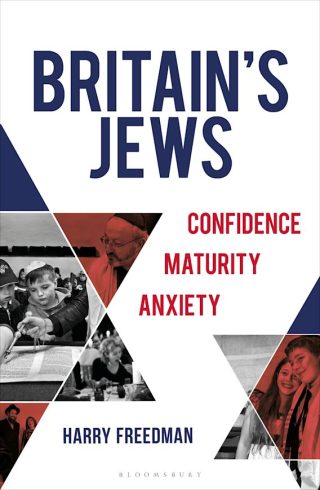
Britain’s Jews: Confidence, Maturity, Anxiety

Britain’s Jews: Confidence, Maturity, Anxiety

I published this book in 2022 before the pogrom of October 7th and the subsequent devastation of Gaza. It is a snapshot of moment in British Jewish history.

This is what I wrote when the book was published:

As a minority, Jews in Britain are confident, their institutions competent and mature. And yet within Jewish life in Britain there is a pervading sense of anxiety.

Jews in Britain have done very well. They have risen to the top of nearly every profession, they run major companies, sit at the top tables in politics, make their voices heard in the media, are prominent in science and the arts.  Of course there is serious poverty and gross disadvantage, just as there is in any community. But on any objective measure, British Jews have done well. Particularly when we consider where they came from, the impoverished, often oppressed lives that many Jews lived in Eastern Europe and the Ottoman Empire less than 200 years ago.Jews have lived in Britain longer than any other minority. They’ve been here so long, and are so ingrained into the national fabric, that they are often not considered to be a minority at all. Until a periodic outburst of antisemitism or a flare up in the Middle East, or both, turns the spotlight on them once again.

British Jews have another distinction too. They have lived safely and securely, continuously, in Britain longer than any other modern Jewish community has lived anywhere else in the world. They have organised themselves in a way that serves as a model both to more recent immigrant communities in Britain and to Jewish communities elsewhere. Being British, they wear their distinctions lightly, they don’t trumpet their achievements, in fact they rarely make a noise at all. But they give back quietly: established Jewish organisations help more recently arrived minorities to create their own structures, charities draw on the Jewish experience of dislocation and persecution to help oppressed people in the developing world, philanthropists support causes far beyond the boundaries of their own communities.

Britain’s Jews is a challenging look at Jewish life in the UK today. Based on conversations with Jews from all walks of life, it depicts, in ways that are at times disturbing, at other times inspiring, what it is like to be Jewish in 21st century Britain. And why Jewish life is still a subject of fascination.

  • / Comments Off on Leonard Cohen: The Mystical Roots of Genius
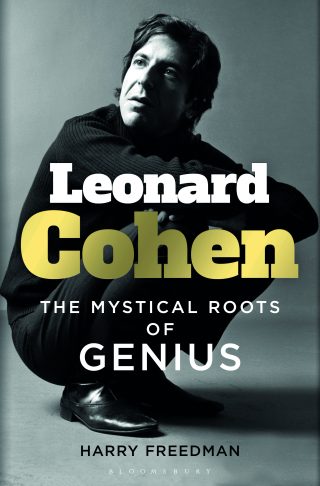
Leonard Cohen: The Mystical Roots of Genius

Leonard Cohen: The Mystical Roots of Genius

I loved writing this book. It explores the religious folklore, spiritual ideas and mystical concepts that run all the way through Leonard Cohen’s music. Cohen was deeply learned in both Judaism and Christianity; they helped shape his self-identity and the way he made sense of the world. His songs are packed with references to the Bible, Talmud and Kabbalah, references which he interpreted in his own unique style, to deliver messages and ideas often far removed from their original context.

Anyone who has listened carefully to Leonard Cohen’s music will know that songs like Hallelujah, Story of Isaac and By the Rivers Dark are based on biblical narratives. But Leonard Cohen’s music contains many more songs based on ancient lore. The Window is packed with kabbalistic insights, Who by Fire is based on both an ancient mystical text and a synagogue prayer, and You Want it Darker is one of the most powerful challenges ever written to the God whose presence Leonard Cohen was always aware of, whose purpose baffled him and whose world he struggled to come to terms with.

In Leonard Cohen: The Mystical Roots of Genius I explore twenty songs rooted in ancient biblical or kabalistic sources.  I explain the sources he drew upon, discuss their original context and the stories and ideas behind them, and show how Leonard Cohen has harnessed them for his own purposes.  The book is not a biography, though it contains biographical information. I hope that it will offer an insight into the soul and imagination of one of the greatest singers and lyricists of our time.

Leonard Cohen: The Mystical Roots of Genius is published by Bloomsbury Continuum .

  • / Comments Off on Shylock’s Venice
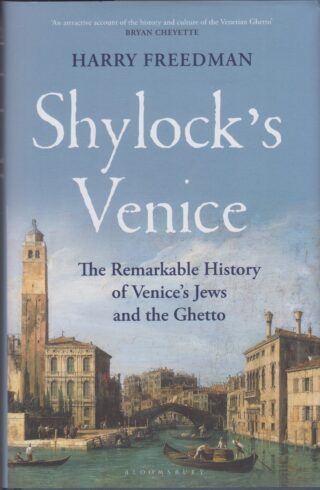
Shylock’s Venice

Shylock’s Venice

I loved writing this book. Not just because Venice is a remarkable place, with a fascinating history. But because the ghetto, where the Jews of the city were confined, has such a fascinating story. Venice gave the world the word ghetto.

The early modern Venetians were nothing if not mercenary. For centuries they excluded Jews from their city. When they did let them in it was for economic reasons, to circumvent the Church’s prohibition on lending money on interest. While taxing the Jews as heavily as they could. And after a few years, exiling them to the ghetto. Although free to walk the streets by day, they were locked behind gates and walls each night.  Astonishingly, the ghetto prison turned out to be as remarkable a place as the city of Venice itself.

From the founding of the ghetto in 1516 until the capture of Venice by Napoleon in 1798, Shylock’s Venice is the story of the remarkable cultural renaissance that took place in the Venice ghetto. Gates and walls notwithstanding, for the first time in European history Jews and Christians mingled intellectually, learnt from each other, shared ideas and entered modernity together. When it came to culture, the ghetto walls were porous.

As the title suggests, this is not just a book about the ghetto. No history of Venice and its Jews can avoid the story of Shakespeare’s Shylock. The cultural renaissance in the Venice ghetto is often obscured from history by this fictional character. Who, we wonder was Shylock? Would the people of Venice have recognised him and what did Shakespeare really think of him? Shakespeare’s ambivalent treatment of his anti-hero reflects attitudes to Jews in Elizabethan England – but the myth is wholly ignorant of the literary, cultural and interfaith revival that Shylock would have experienced.

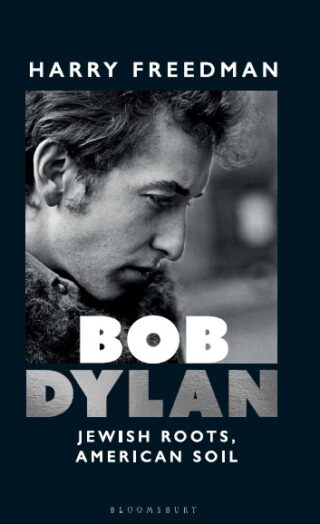
Bob Dylan: Jewish Roots, American Soil

Bob Dylan: Jewish Roots, American Soil

Bob Dylan went from unknown to superstardom during some of the most turbulent times in modern American history. The McCarthy years, when anyone suspected of communist leanings was ostracised, however weak the evidence, took a terrible toll among musicians, writers and creatives, some of whom moved in the same circles as Dylan. The struggle for civil rights tore American society apart and the assassination of President Kennedy traumatised it, destroying hopes, ideals and dreams. If that wasn’t enough, the Vietnam War radicalised the post-war generation, baby-boomers as they were known.

Those few years are the subject of this book. Relentlessly driven, unafraid of change, and seeing far into its consequences, Dylan harnessed the spirit of the age to explore new ways of delivering his messages and ideas. Provocative or accusatory, inspirational, mystifying or entertaining, Dylan never lacked the element of surprise. Speaking out in the service of justice and truth, daring to stand up to his detractors, a man never prepared to be cowed. Even when it meant upsetting some of his fans and alienating segments of his audience.

Like any outstanding creative, Bob Dylan’s work is the product of multiple influences. Widely read, there seems to be no end to the poets and authors he echoes. Musically too, he draws upon the entire spectrum of contemporary genres, from folk and blues through to jazz, country, rock and pop. However, three great cultural influences truly moulded him as an artist: Woody Guthrie, the man he wanted to emulate as a folk singer at the start of his career. The Beat poets, whose use of language, seemingly boundless perspective and elevated awareness opened new horizons, expanding his world view. And his Jewish ancestry, which rarely affected him consciously but furnished him with traits and values, shaping him into the person he had no choice other than to be. All three of these primary influences are encapsulated in the title of my latest book, Bob Dylan: Jewish Roots, American Soil.

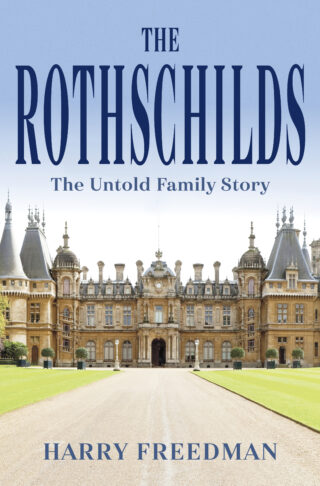
The Rothschilds: The Untold Family Story

The Rothschilds: The Untold Family Story

My next book, The Rothschilds: The Untold Family Story will be published on December 8, 2026 in the USA and January 14, 2027 in the UK.

The Rothschilds have been a fixture in the Jewish world for almost 250 years. A constant presence during an otherwise tumultuous time, in which Jews emerged from the ghetto, fought for emancipation, endured horrendous pogroms, migrated in their millions, suffered bestial mass slaughter, founded a sovereign state and ended up, at least for now, playing a full and equal role in contemporary society, just like everyone else.

The Rothschilds have been there throughout. Different from ordinary Jews because of their fabulous, some might say obscene, wealth, they have been an augur of stability. Reliably philanthropic, they dispense largesse to charities, sit on the boards of major institutions, support the arts, fund research into science and medicine and play their part in the culture and governance of the nations where they have made their homes. Earlier Rothschild generations built palaces and pleasure gardens, entertained expansively, amassed stunningly valuable art collections, owned stables of race horses, made the finest of wines and bankrolled developing nations. As a dynasty, they have never forgotten their ghetto origins, nor the values of philanthropy, communal service and family solidarity inherited from their progenitor. They founded, funded and led Jewish communal bodies and welfare organizations, campaigned for the emancipation of their people, acted as advocates on behalf of persecuted Jews in far off places and donated to their resettlement in more welcoming environments.

The Rothschilds: The Untold Family Story is the story of a family. It is not a dynastic chronicle nor a biography of individual family members. Nor is it a catalogue of the dealings of the various Rothschild banks and finance houses; such endeavors would not be possible in a work of this length. I have tried to produce a readable and brisk journey through the family’s history, telling the stories of the principal characters, looking at their achievements, their eccentricities and predilections, and the differences they made to the times in which they lived. Theirs is a story well worth telling.

© 2026 Harry Freedman Books