Monthly Archives: November 2023

The Sweet-Sounding Voice of Madama Europa

The Little Known Story of the First Jewish Opera Singer
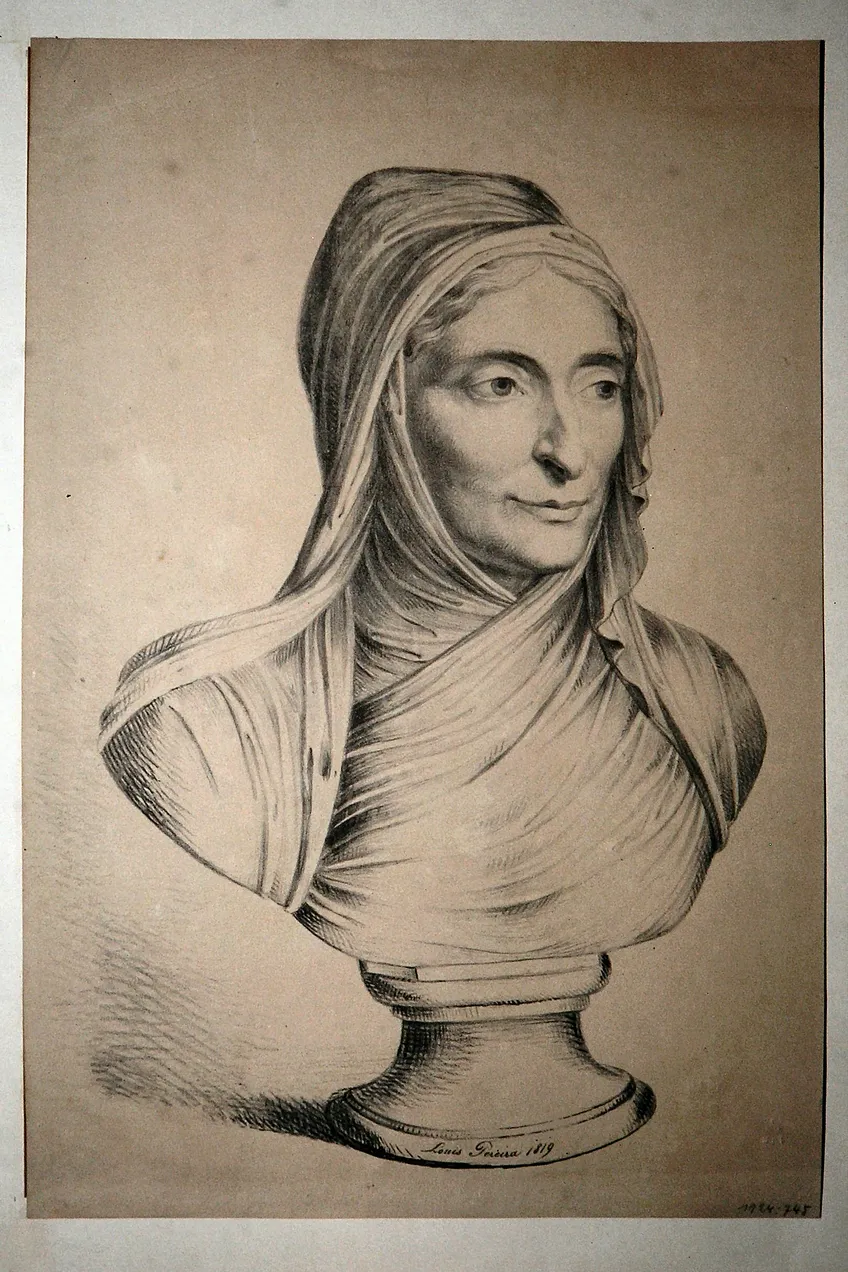
She was one of the first Jewish women to sing in public and almost certainly the first female, Jewish opera singer. Yet very little is known about Europa di Rossi, or Madama Europa, as she is usually termed. When she is mentioned in the history books it is generally as an aside, or in a discussion of her more famous brother, the musician and composer Salamone Rossi. But Madama Europa deserves a mention of her own.

Madama Europa’s name appears in the list of singers who received a salary at the court of the Duke of Mantua in the 1590s. Mantua was a small, independent Duchy, squeezed between the dukedom of Milan and the powerful Venetian Republic, with a ducal Court that was renowned as a major centre of art and culture. Madama Europa worked with the composer Claudio Monteverdi, she sang in the premiere of his opera, Arianna, and performed his arias for the rest of her career. While she was at the Court she would have met astronomers and poets, she may well have bumped into the artist Peter Paul Rubens and perhaps even have encountered Galileo, when he tried to negotiate a position for himself in the Duke’s employ, in 1603.

Read more at https://harryfreedman.substack.com/p/the-sweet-sounding-voice-of-madama
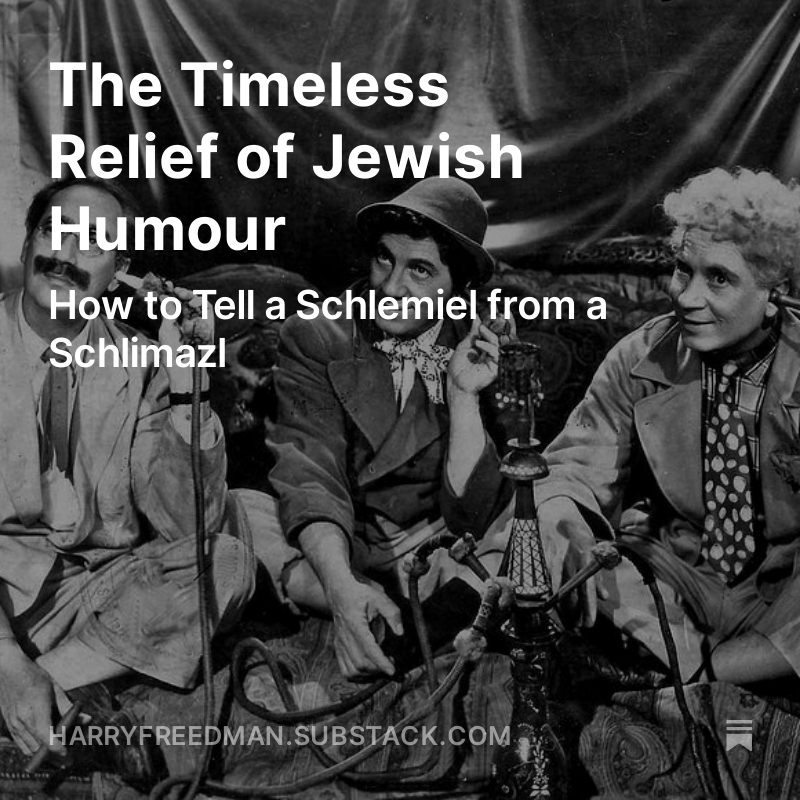
The Timeless Relief of Jewish Humour

How to Tell a Schlemiel from a Schlimazl

Sigmund Freud once famously wrote that all Jewish humour is self-parody, that Jews make themselves the butt of their jokes. He may have been thinking of the sages of Chelm who were so racked with worry that they couldn’t function properly. So they decided to pay the beadle 2 roubles a week to worry for them. Until they realised, that now he was earning 2 roubles a week, he had nothing to worry about.

Freud, as we’d expect, diagnosed Jewish humour in psychological terms. Jews self-deprecated as a way of shrugging off any sense of inferiority they had as an oppressed people. But Freud was only writing about a specific sort of Jewish humour; the Yiddish humour of his time and place and, even so, he was only partially correct. There are many Jewish jokes which, far from being self-deprecating, present a sort of Jewish exceptionalism…..

Read more at https://harryfreedman.substack.com/p/the-timeless-history-of-jewish-humour

The New York Rent Disputes

When Talmudic Law was Cited to Protect Tenants’ Rights

During and after the First World War many American cities experienced severe housing shortages. Numerous landlords took advantage of the demand in the real estate market by increasing rents exorbitantly and evicting those who could not pay. The courts were overwhelmed with eviction proceedings and in April 1920 the New York State Legislature stepped in to remedy the crisis. They imposed various restrictions on landlords but poured oil on the flames by allowing rent increases of up to 25% and declaring that all leases that were not of fixed duration would terminate at the end of September. It meant that landlords could serve eviction notices on tens of thousands of tenants, greatly adding to the housing crisis.

To try to remedy their error the Legislature passed a series of Emergency Rent Laws. They froze eviction proceedings for 2 years and demanded that rent increases had to comply with statutory tests of reasonableness. The landlords pushed back, setting off a flood of law cases in the State courts, the New York Court of Appeals and in some cases, the Supreme Court….. Read More at https://harryfreedman.substack.com/p/the-new-york-rent-disputes

A Salonnière in Vienna

How Fanny Arnstein Broke Down Barriers for Jewish Women

Her name rarely appears amongst those said to have advanced the cause of Jewish women; indeed she would have said that was never her intention. But arguably her wealth, status and privilege enabled Fanny Arnstein to make an unrivalled contribution to the position of Jewish women in patriarchal, antisemitic, early 19th century Austria.

When Fanny Arnstein was born, the vast majority of European Jews still lived the same impoverished lives as had their ancestors: excluded from mainstream society, rejected as an outcast faith. One of the few occupations permitted to them was money lending, usually just small time pawnbroking that left them as poor as their customers. Some who were more business minded became merchants; one advantage of belonging to a dispersed people was to be part of a wide geographical network of contacts. And there were just a few, no more than a handful of Jewish families, who were a bit sharper, a bit more entrepreneurial, who built substantial businesses by combining the permitted occupations of trade and moneylending. By the end of the 17th century these few families, with names like Oppenheimer, Gumpertz and Liebmann were supplying the royal houses and courts of Europe with the funds and provisions they needed to remain in power. They became known as Court Jews…… Read more at https://harryfreedman.substack.com/p/a-salonniere-in-vienna

The Man Who was Not James Bond

Who, really, was Sidney Reilly?

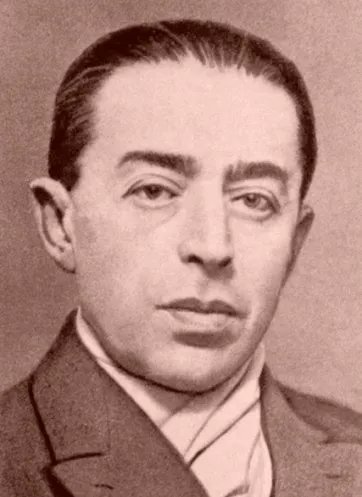
When Ian Fleming was asked who the inspiration was for James Bond, he is supposed to have said “He’s not a Sidney Reilly.” But in several conversations he did imply that James Bond was in part modelled on Sidney Reilly. Still, James Bond was not Sidney Reilly. And, indeed, Sidney Reilly was not Sidney Reilly.  As far as anyone knows, Sidney Reilly, the Ace of Spies, the most famous of all pre-war British agents, a man about whom dozens of legends have been told, was born as Sigmund Rozenblum in Odessa. Though some say he was Shlomo Rozenblum from Kherson in Ukraine. Or perhaps Sigmund Rozenblum from Poland.

As befits any good spy, Sidney Reilly’s life is shrouded in mystery. He has been the subject of several biographies, each one telling different stories about him. He did not remain Rozenblum for long. In 1899, four years after he arrived in London, he was carrying a passport in the name of Sidney George Reilly. Though he didn’t manage to lose his Yiddish accent as quickly as he lost his Jewish name…… Read more at harryfreedman.substack.com/p/the-man-who-was-not-james-bond

The First Pogrom?

The Riots of 38 BCE as told by Philo of Alexandria

For at least 300 years, Greeks, Jews and Egyptians lived alongside each other, fairly harmoniously, in the Mediterranean port of Alexandria. The harmony was shattered in the year 38 CE when the city became the scene of the world’s first pogrom, or at least the first pogrom known to history.

Originally, Alexandria was a Greek city, founded by Alexander the Great. The Romans took it into their Empire in 30 BCE but its Hellenist social structure remained much as it had always been in the past. The Greeks were the upper class, urbane and suave, dwelling in the best neighbourhoods and sharing a vestige of political power. The lower class was Egyptian, those whose families were native to the land, who had not been able to buy themselves into the upper echelons. They lived semi-rural lives….. Read More at https://harryfreedman.substack.com/p/the-first-pogrom

Trapped in an Island Ghetto

The 600 year misery of Majorca’s forgotten Xuetes

You may have seen a newspaper article last week about the parliament in Majorca. They have just acknowledged the centuries of discrimination and persecution that were heaped upon the local Xueta community – descendants of Majorcan Jews who became known as conversos because they were forcibly converted to Christianity in the 14th and 15th centuries.

An acknowledgment is not the same as an apology and the declaration that the parliament made has no legal force but it was something of a breakthrough. For the first time, the government of Majorca has formally faced up to the fact that for over 600 years they have shamefully treated the descendants of those forced to convert to Christianity. The Majorcan Parliament’s resolution follows (though may not be linked to) Xueta Island, a documentary about Majorca’s ancient Xueta (or Chueta) community, released last year by the New York film maker Dani Rotstein….. Read more at https://harryfreedman.substack.com/p/trapped-in-an-island-ghetto

Disraeli’s Devotion

The Future Prime Minister’s Enthusiastic View of History

Before he became Prime Minister of Britain, Benjamin Disraeli wrote several novels. Among them, although one of the least well known, was The Wondrous Tale of Alroy, a historical fantasy set in 12th century Persia. The hero of the novel is a tribal leader named David Alroy, a Jew upon whom Disraeli bestowed the title of Prince of the Captivity.

In the novel, David Alroy, who comes across as a sort of Persian King Arthur, commanded an army that had many unbelievable adventures and won several impossible battles. One day he was told by a sorcerer that if he were to go on a quest to Jerusalem to retrieve King Solomon’s sceptre, he would be able to restore Israel to its former glory. He would, in effect, be the Messiah. Fired with enthusiasm, Alroy set off with his army, enjoying further adventures and winning more battles on the way, until he got to Jerusalem and recovered the sceptre. Sadly, after even more adventures, for reasons that it is pointless to go into, he lost the sceptre and his messianic mission was doomed. The book ends with Alroy being beheaded, dying with a smile on his face. Read more at https://harryfreedman.substack.com/p/disraelis-devotion

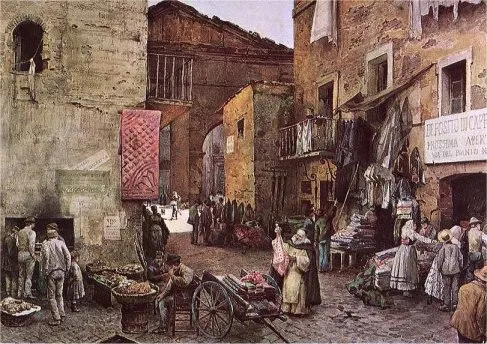
False Hope and Squalor on the Banks of the Tiber

How the Jews of Rome were forced back into the Ghetto

By the middle of the 16th century, many European cities had confined their Jewish population into a ghetto, a slum bounded by walls and gates in which only they were permitted to live. Cities like Frankfurt and Prague had long set aside areas where Jews were obliged to live but it was in 1516, in Venice, where the first formal ghetto was established, a prison-city which no Jew was allowed to leave at night.

The ghetto in Venice was a miserable place but the presence of so many people cloistered together in their own cultural bubble led to a remarkable creative renaissance[*]. The ghetto in Rome, the second of 41 to be established in Italy, was very different. Sited on the banks of the River Tiber, it was a truly unhappy place. Rome’s ghetto was established in 1555 by Pope Paul IV as the most severe of several discriminatory measures that included a ban on Jews owning property, trading in foodstuffs and employing Christians. Jewish doctors were forbidden to treat Christian patients and Christians were not allowed to greet Jews using a courtesy title like signor or signora. The Pope, who had been the driving force behind the public burning of the Talmud in Rome two years earlier, issued his decree in a papal bull entitled cum nimis absurdum. The name means ‘just as it is absurd’ and is taken from the opening words of the bull  which declares it absurd that Jews, “whose own guilt has condemned them to perpetual servitude” should live side-by-side with Christians and have equal rights. Read more at https://harryfreedman.substack.com/p/false-hope-and-squalor-on-the-banks

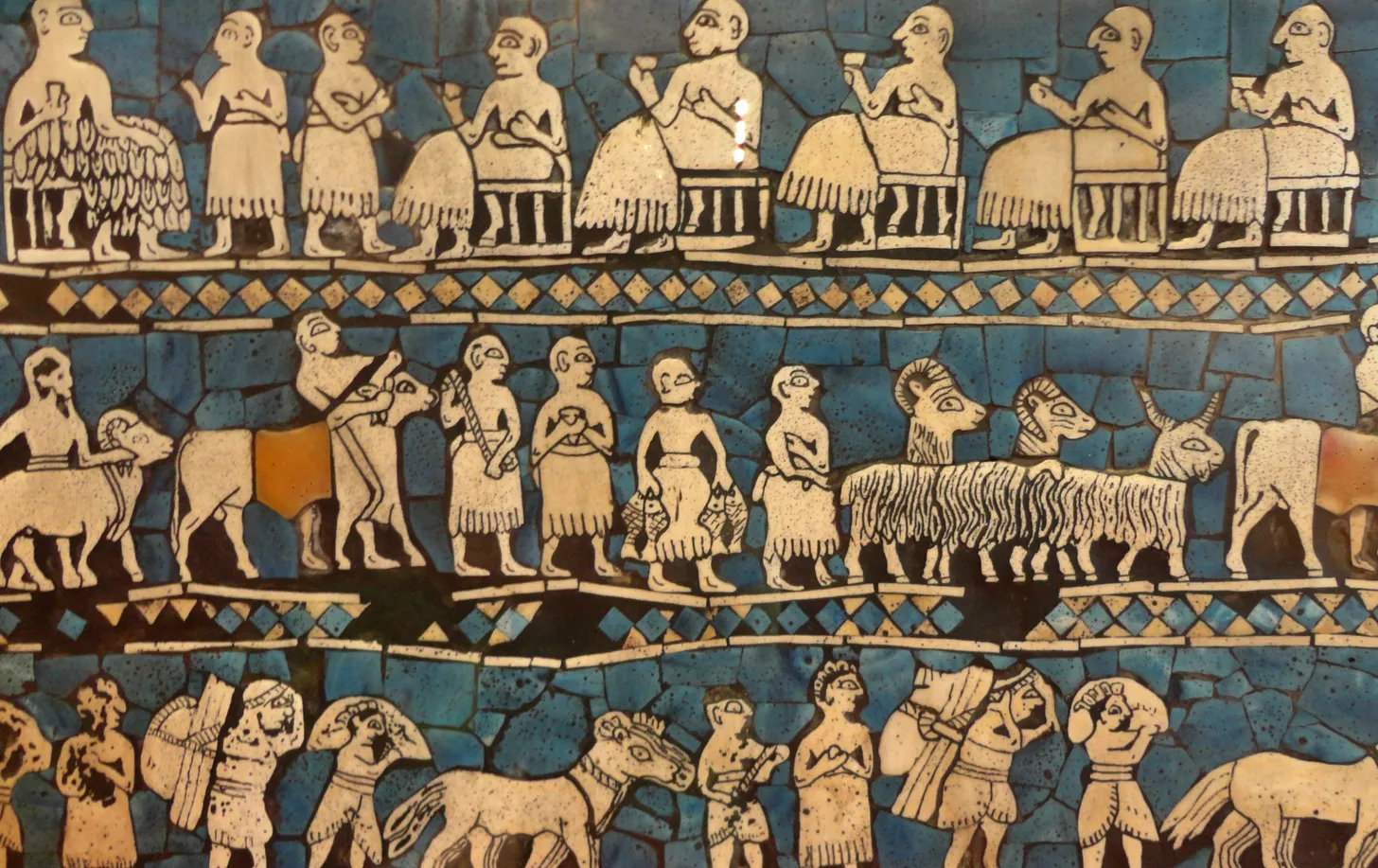
It’s New Year in Sumeria

Changing the Year, Long Ago

At first sight the Jewish New Year, which falls this weekend, has nothing in common with New Year’s Day as we know it. The secular New Year is a time of celebration, of partying, of  counting down the seconds to midnight. It is a season of good cheer, of lustily singing Auld Lang Syne, even though few of us know, or even care, what the words of the song mean.

The Jewish New Year, in contrast, is a sober event. It is a time for reflection and introspection, a time to repair our relationships with each other, a season of prayer and repentance. Yes, there is a sweet dimension to it, symbolised with honey, and there are a few mystical, food-based, rituals that have been popularised and used as augurs of renewal, but they hardly compare to the fireworks, the excitement and festivities of New Year’s Eve. Hand on heart, we can’t really say the Jewish New Year is fun. Not that it’s miserable either, that’s not the idea, but it is serious and reflective. It is a religious event, not a secular one…. Read more at https://harryfreedman.substack.com/p/its-new-year-in-sumeria

© 2026 Harry Freedman Books